Week 3: Making the Third World: Truman’s Point Four, Third Worldism, and the New International Economic Order
DVST 6901: The global politics of development (Semester 2,
2026)
August 17, 2026
20th century development is a creature of the Cold War and the post-WWII “new world order.” Hence, development as goal and ideal has always been contested. We live in the aftermath of competing alternative concepts of development and competing ideological values and critiques.
Main reading: Getachew (2019), chaps. 3, 5; “Text of the Final Communiqué of Asian-African Conference” (1955); United Nations General Assembly (1974)
Other reading: Rist (2014), chap. 4-6; Illich ([1970] 1973)
Notes
Notes to be added later.
Keywords
Third Worldism and the Non-Aligned Movement, The Allied powers, the United Nations, and the Cold War politics of development
Learning outcomes
- Be able to take a stand on past approaches to change and to identify important ideological contrasts in these approaches
A new culture for a new international community
Discuss in small groups what you wrote about for your weekly assignment.
You wrote about a counterfactual, fictional League of Nations that gives a new mandate to powerful societies who rule over powerless societies. Now let’s generalize.
What kind of supervision or oversight should a government have? Who is accountable to whom?
In the absence of “self-government,”
what would you prohibit a government from doing to those that it governs?
what would you require that government to do to or for those it governs?
What would count as success and what would evidence of success be?
And based on your discussion today
- What kind of new New World Order would you want to establish by this system? What are the different values, ideals, and aspirations do we as a class have? (Here, focus on what we have in common and what is different and where people in your group disagree.)
Another war, another peace
US presidents go down in history for their soundbites:
- “The Great Society”
- “A shining city on a hill”
- “A thousand points of light”, or “A kinder, gentler nation”
- “A bridge to the 21st century”
- “Compassionate conservatism”
And “international development.” Truman mentions this in his 1949 inaugural address as a new foreign policy because it sounded good and would make the other three points sound like they were part of a more ambitious vision (Rist 2014, 70).
Everyone started talking about development in a new way. No one has ever known what it meant. It’s not colonialism. It has something to do with the UN and world peace or something. And there’s science and technology.
- Development is technical and economic
- Development is realization of existing potential, and hence a society can be “underdeveloped”
- to develop is a transitive verb, i.e. The West develops the underdeveloped societies of the world, and not A society develops over time (Rist 2014, 73).
Is development an aim for our new New World Order?
- Did your groups discuss development and what did it mean for you?
Liberty versus democracy in the postwar era
- Self-determination and material improvements compete for priority in
across different ideological positions.
- They aren’t alternatives that are opposed, like black and white or night and day. The question is whether one is necessary for the other.
- And they can’t be separated. Even if you conclude that one is more important and prior to the other, advancing that ideal involves addressing the other.
- When self-determination is embraced as a right, it’s as a “human”
right, i.e. an extension of the natural rights of individuals.
- This points to another dimension of the new global politics: Liberty versus democracy
Discussion point: What’s so great about human rights?
If human rights is the highest value, and we judge a society by its respect for human rights of its individual members, what do we miss?
What do we think? Is there something more important than human rights?
Front page news
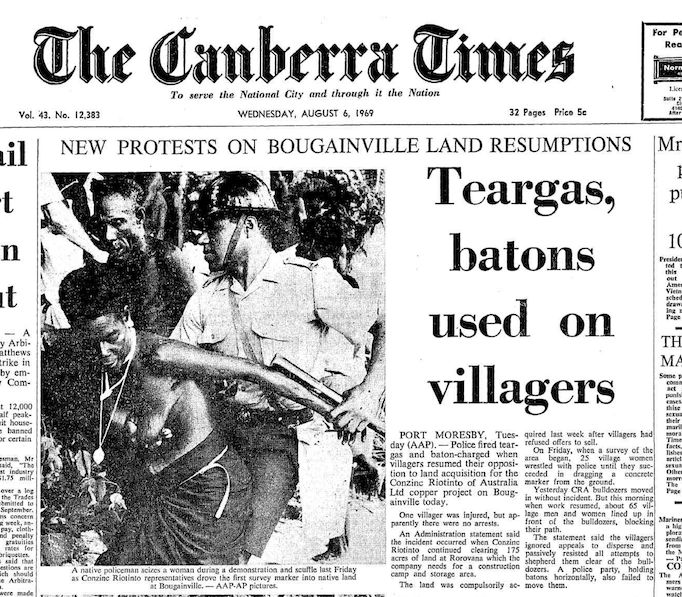
For the full article, go to Trove:
Canberra Times (Australian Capital Territory). 1969. “New Protests on Bougainville on Land Resumptions: Teargas, Batons Used on Villagers.” August 6. http://nla.gov.au/nla.news-article136948011.
Bougainville: The beginning
- 1886–1945 — Colonisation
- Anglo-German accords of 1886 and 1899 place Bougainville, geographically part of the Solomons chain, within German New Guinea.
- 1914: Australia occupies German New Guinea.
- 1921: Australia granted a League of Nations ‘C’ class mandate.
- 1942–45: Japanese occupation of Bougainville and Buka.
- 1945: UN trusteeship of the former mandated territory under Australian administration.
- 1964–67 — Copper deposits found at Panguna
- Drilling identifies a large low-grade copper-gold porphyry deposit.
- Landowners oppose prospecting, arguing that ownership of the land entails ownership of the minerals.
- Thousands of white and non-Bougainvillean PNG workers, known as “redskins” to Bougainvilleans.
- Paul Lapun, representative for south Bougainville, wins a 5% royalty stake for landowners.
- August–September 1969 — Rorovana landowners protest
mining
- Land at Rorovana, Anewa and Arawa compulsorily acquired for the port, town and mine infrastructure.
- 1 August: surveyors enter under escort by three police riot squads.
- 6 August: villagers, women prominent among them, lie down before the bulldozers and are dispersed with tear gas and batons; footage is broadcast in Australia.
- August: a High Court challenge to the Special Mining Lease is dismissed.
- April 1972: commercial production begins at Panguna.
Bougainville: Towards PNG’s independence
- 1966–1975 — An emerging discontent and new national
consciousness
- 1973: the Bougainville Special Political Committee is established under Leo Hannett’s chairmanship to define Bougainville’s political aspirations and act as a pressure group, bringing together traditional leaders, young educated Bougainvilleans, MHAs, local government council presidents, and representatives of non-council areas and the outlying islands.
- 1975: Hannett publishes “The Case for Bougainville Secession” in Meanjin Quarterly.
- 1 September 1975 — Unilateral declaration of
independence
- The Republic of the North Solomons is declared fifteen days before PNG’s independence on 16 September.
- Alexis Sarei, district commissioner 1973–75, serves as president of the Republic of the North Solomons from 1975 to 1976 and as premier 1976–80 and 1984–87.
- Grievances cited include mining, environmental damage, relocation of landowners and the influx of outsiders.
- After approximately eleven months of negotiation with Somare, Bougainville accepts reintegration in exchange for provincial autonomy.
Bougainville: The war, the blockade, and then autonomy
- 1988 — Ona’s demands
- The Panguna Landowners Association, led by Francis Ona and Perpetua Serero, demand K10 billion in compensation, a fifty per cent share of profits, localisation of company ownership within five years, and stronger environmental controls, which is refused.
- From late November 1988, supporters destroy transmission pylons serving the mine.
- May–June 1989 — Mine closure and state of emergency
- Panguna closes and PNG declares a state of emergency and imposes curfews.
- BRA ideology identifies the company, the national government and “redskins” as responsible for destroying an egalitarian traditional society.
- 1989–1997 — PNGDF and BRA at war
- Riot police, then the PNGDF, deploy to fight the BRA and capture Ona.
- 1990 — Withdrawal, evacuation and blockade
- March: PNG withdraws its security forces; Australian nationals and BCL employees are evacuated; the island passes to BRA control.
- May: the blockade begins. Manufactured goods and medicines cease reaching Bougainville and the cash economy collapses.
- The blockade remains in place until the ceasefire of September 1994, and informally in much of Bougainville until 1997.
- 1997–2019 — Peace process and referendum
- 30 April 1998: permanent ceasefire.
- 30 August 2001: Bougainville Peace Agreement — autonomy, weapons disposal, and a guaranteed referendum deferred ten to fifteen years.
- 2005: the Autonomous Bougainville Government is seated.
- 23 November – 7 December 2019: referendum returns 97.7 per cent for independence over greater autonomy; the result is non-binding on PNG’s parliament.
Bougainville: What’s next?
- 2026 — Current status
- June 2026: PNG’s parliament adopts a Sessional Order to consider the referendum result; the Speaker sets the ratification threshold at three-quarters of MPs, above the two-thirds usually required for constitutional amendment.
- 27 August 2026: the referendum result set down for tabling in the National Parliament.
- The ABG is preparing for self-government from September 2027 and has stated its intention to declare independence in 2030.
- Reopening Panguna has been raised by the ABG as a revenue base for statehood.
Bougainville: Appendix
Sources
Primary
- Bougainville Copper Agreement (1967); Barnes submission to Cabinet, 13 January 1967, and the McDonald–Somare record of conversation, 19 September 1968, in DFAT, Documents on Australian Foreign Policy, vol. 26.
- Bougainville Peace Agreement, Arawa, 30 August 2001; Bougainville Referendum Commission results, December 2019.
Secondary
- James Griffin, “Napidakoe Navitu,” in R.J. May (ed.), Micronationalist Movements in Papua New Guinea (ANU, 1982), ch. 4, pp. 113–138. Ethnic self-perception p. 113; the 1964 influx and “redskins” c. p. 119; Middlemiss, Bougainville News and the 1970 ballot pp. 127–129; the Goroka killings p. 135; the 1982 repatriation march p. 138.
- Leo Hannett, “Down Kieta Way: Independence for Bougainville?”, New Guinea and Australia, the Pacific and South-east Asia 4, no. 1 (1969): 8–14; “The Case for Bougainville Secession,” Meanjin Quarterly 34, no. 3 (1975).
- JSCFADT (Parliament of Australia), Bougainville: The Peace Process and Beyond, ch. 2 and Appendix D (1999). Ethnicity and skin colour ¶2.12–2.13; Buka/mainland tension ¶2.15; BRA ideology ¶2.41; secession as reaction to security force conduct ¶2.42; targeting of non-Bougainvilleans ¶2.51; Buka invites the PNGDF ¶2.53; care centres ¶2.56.
- D. Denoon, Getting Under the Skin (MUP, 2000); A. Regan and H.-M. Griffin (eds), Bougainville Before the Conflict (ANU, 2005).
AI acknowledgement
This timeline was compiled with the use of a generative AI tool (Claude Opus 5) which summarized and retrieved information from supplied PDF copies of published sources and from web searches. The facts and sources were checked by Ryan and the timeline was edited by Ryan.
A counterfactual response to the Bougainville crisis
Your fictional League sought to manage the end of colonialism. Now imagine that you can create your own international order in which PNG and Bougainville are parts. PNG gains its independence in 1975. When Bougainville has problems—from the 60s to now—your ideal international body is in charge.
- Who should be in charge?
- What can PNG do and what can’t PNG do?
- What is your desired result?
Discuss.