Week 6: Spheres of exchange
ANTH 1002: Anthropology for a better world (Semester 2, 2026)
September 8, 2026
There are some things that can’t be exchanged, and some things that money can’t buy. The theory of reciprocity leads to a model of how societies organize the flow of material things, and it works differently in every society, including yours.
Main reading: Reyes-Foster and Carter (2020)
Other reading: Addo and Besnier (2008); Bohannan (1959); Bohannan (1955)
We got apples

Commodities and capitalism
- Commodities are bought and sold for a price.
- You can think of commodities as a “sphere of exchange.” When you exchange commodities for money, and back again, you are following certain rules.
- The sale of commodities generates a profit.
- A system of producing, selling and distributing commodities as the main form of economic system is associated with capitalism.
Private property creates a new kind of society
For capitalism to emerge, first the concept that one’s property can be owned privately has to be instituted.
- Private property gives me the right to exclude other people from my property, like a fence.
Talk about selling out…
A worker under capitalism brings “his own hide to market and has nothing to expect but – a hiding” (Marx [1867] 1972, 343).
What do you think he means by this? Buzz about this. What do you associate with the word Capitalism? Marxism? When did you first hear these words? Have you ever read the Communist Manifesto?
What really is the difference between gift and commodity?
This might sound like a simple dichotomy:
societies based on gifts, reciprocity, and a system of total services;
capitalist societies based on commodity production and consumption.
Instead, consider this possibility:
Every society is based on a system of total services, even if its members don’t know it and cannot see it.
Some societies impose a specific set of social fictions:
- valuable things can be private property, and
- your body and your labor power is your private property, and you can sell it if you have to.
We see both the reality of society and the fiction of individual alienation in every society, and they interact in several different ways.
A side note: There is a paradox in our concept of society
Bourgeois culture teaches us that we are each individual economic actors and that there is no society on which we depend.
But societies are real. We really are all part of a system of total services.
Yet, also, every society is based on a fiction.
We need to be part of a social order
But any one social order will involve lying to ourselves. * And some social fictions completely obscure the existence of any social ties.
Is everything a gift? Really?
Mauss argues that every exchange is a gift, and every gift comes with three obligations: to give, to receive, and to reciprocate
You may be skeptical. That’s good. Stay skeptical.
In the contemporary world, every one of us, and most people on Earth, will meet some needs by buying and selling. Typically buying and selling does not involve ongoing ties of interdependence.
Then again, we should not assume that self-interested economic transactions are universal either, and that every exchange is also an example of rational maximization by individuals.
Karl Marx’s theory of capitalism gives us a new perspective on markets
Like Mauss, Marx also challenges the idea that economic self-interest and rational maximization are part of a universal human nature.
Mauss tells us to think globally. Marx tells us to look at history.
People have used money and currency of some kind for 1000s of years. That’s not new.
What is new is the idea that owning also gives the owner a right to deny its use to other people. Private property is exclusive ownership. This is a new invention.
When a society protects private property, then rich people can own all of the productive resources (capital) that a society needs to meet everyone’s needs. One class owns all the capital; everyone else has no say over a society’s means of production.
The new ruling class—the owners of capital, or the bourgeoisie—produce commodities with other people’s labor.
What is Mauss really saying?
When you first hear Mauss’s ideas, it may sound like there are two types of society:
- Societies based on gifts and reciprocity
- Societies based on private property, capitalism, and markets
This is how Mauss sounds if you look at the world through the lenses that bourgeois culture gives you.
No. Mauss is arguing for a new view of all societies.
The pull of reciprocity, and of the social whole, is still there even as commodification challenges it.
Is everything for sale?
What did you write about for this week?
Share with each other.
- If something cannot be sold, what can you do with it?
An editorial decision
Portland, Oregon, 1997. The Reed College Quest editors meet to discuss an inquiry about a classified ad.
Nobody involved can remember what it said. It was something like this:
“WANTED Healthy female student to help bring joy to an infertile couple. Will pay $3000 plus all medical expenses for a donation of several eggs. Candidates should have a minimum GPA of 3.5 and minimum combined SAT scores of 1600.”
(GPA: grade point average, 3.5 is approximately a WAM of 80. SATs are college entrace exams. Under the old system, 1600 would have been close to an ATAR of 95.)
Meanwhile…
Wendie Wilson was a student at the University of Washington around the same time. She volunteered to give several eggs for $5000.
“It seemed a relatively small amount of my time for what seemed to be pretty decent compensation.” It was empowering (Tuller 2010).
She later founded an egg donor registry, Gifted Journeys.
Human trafficking?
A friend recalls similar ads in student publications at a university in Vancouver, British Columbia. “We had ads at my college in Canada too, even though selling eggs isn’t legal there. I guess they would ship you to the US for the procedure” (personal communication, 2014).
What the ads ask for
- University students (women who have more and better-quality ova).
- Preferred hair and eye color.
- Prefered race.
- Prefered school. Ivy-league (Harvard, Yale, etc.) schools are especially popular, as are Berkeley and Stanford.
Not for sale?
Unlike many countries, the sale of gametes is largely unregulated in the US, and the US has generally looser regulations on IVF and surrogacy. (PDF version.)
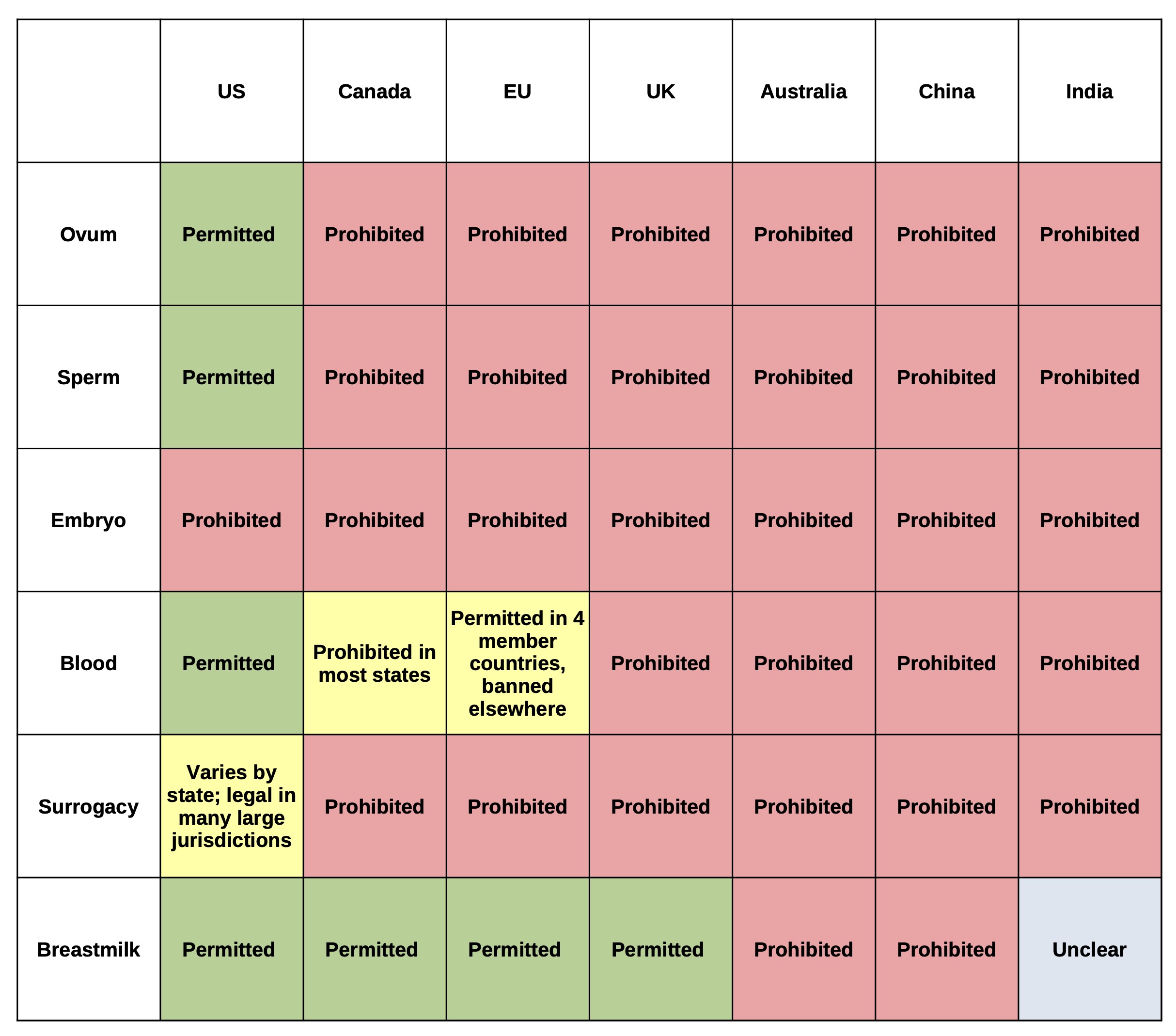
Why do people exchange breastmilk? Why do others prohibit its sale?
In practice, people choose to buy, sell, and exchange breastmilk even though some kinds of exchange are illegal.
- In many societies, mothers offer the service of breastfeeding to
each others’ children.
- This even creates “milk kinship” among children fed by the same woman (Clarke 2007).
- Nursing makes a baby your child, and two children of the same nurse are siblings. For that reason, Islamic teachings forbid milk banking. Donated milk can’t be anonymous. What if the recipients get married? (Ghaly 2012)
- There are groups in Australia who want to promote voluntary, unpaid wet nursing (Zillman 2019).
- The Australian Breastfeeding Association (ABA) calls milk sharing
“cross-feeding” and considers it and other kinds of sharing risky (“Donor
Milk” 2022).
- They promote “milk banking” which accepts donations of milk which are sterilized. Donating is OK only if it is anonymous and entails no social embeddedness or ongoing obligations.
- Florida mothers care about the same standards that the ABA and
doctors do, but they don’t need a bank to do that. Rather,
- Hygiene is a personal quality of donors. It shows they can be trusted.
- Generalized reciprocity is a shared ethos among network participants, and by adhering to generalized reciprocity as an obligation of membership, people feel confident in what they give and receive.
Gray areas in the exchange of white gold
In 2017, the Cambodian government banned the sale of breastmilk in response to the arrival of a US corporation which produces milk products (Wong 2017).
What is your response to this? What does your gut say? Good or bad?
Give yourself permission to speculate. Consider your opinions as hypotheses to test or ideas to explore. What is the real issue that the Cambodian government is seeking to address?
Every society is a product of history, and the incorporation of commodity exchange is a big part of every contemporary society’s story
- No social system is pure
- Reciprocity and commercial exchange of commodities are both potentials in any situation
- No society exists in isolation. Every society has a history.
- The encounter between reciprocity and capitalist commodification is a major part of every society’s contemporary history.
- When they come together, they push against each other, like two opposed magnets.
Tiv spheres in a colonial context
According to Guyer (2004), the Tiv spheres of exchange are not a tradition, and not frozen in time. They are a historical phenomenon.
- Brass rods work like a kind of currency (noted also by Bohannan), but this a medium of exchange that Tiv keep out of the hands of banks.
- Cash transactions are morally judged, but not because spending money is prohibited or sinful. Money-exchange means a loss of control over Tiv people’s collective wealth as a community.
- Suspicion of money is a political statement, not by an individual ideologue, a political party, or an organization—but by the social whole itself.
Taro gardening in Wamira, PNG and Luo land ownership in Kenya
One of the ways societies respond to market forces is by placing limits on individual choices
- Wamira (Papua New Guinea) taro gardens can’t be tended with metal tools (Kahn 1986)
- When Luo (Kenya) people sell land, they earn “bitter money” (Shipton 1989)
Potlatch: Giving and global trade
In the 18th and 19th centuries, and after a revival in the 20th century, Indigenous societies of the Pacific Northwest Coast of North America celebrated huge feasts known as potlatch (which means to give)
- Gifts exchanged between different communities’ leaders were competitive in nature, each trying to give more than the other could give back (Mauss [1925] 1990, 6–7, 38–40; Eriksen 2015, 224–25).
European presence in North America after 1800 gave people more sources of wealth for potlatch gifts, and potlatch prestations grew (Wolf 1982, 184–92).
- Colonial contact did not compel people to abandon potlatching, but stimulated its growth and expansion, until it was banned by Canadian law as a political threat (which was repealed in 1951).
The efflorescence of exchange
“The first commercial impulse of the local people is not to become just like [the West], but more like themselves” (Sahlins 1992, 13).
As a Kewa leader once told an anthropologist (paraphrase): “You know what we mean by ‘development?’: building a hauslain [a village community], a men’s house, and killing pigs. This we have done (quoted in Sahlins 1992, 14).
Change in a society may look like what bourgeois culture says is development, but it could be that you mistake what you are seeing
- In rural PNG societies to develop is really the enrichment of their own ideas of what mankind is all about (Sahlins 1992, 14).
Ongka’s “big moka” is an example of efflorescence in PNG. Is there an example of develop-man in Sydney or where you live?
Recap: What happens when reciprocity and commodification meet?
A society might try to deny the fact of reciprocity, and strip the obligations from the gift.
It might segregate reciprocal exchange and market trade to different spheres.
It might subordinate commercial profit to the sphere of competitive reciprocity, leading to an efflorescence of a society’s total system of reciprocal ties.
Notes for tutorial
In this week, we continue to look at the ambiguities and contradictions that emerge in the encounters between the logic of the gift and the logic of the commodity, private property, and capitalism.
We have already discussed Paul Bohannan’s concept of “spheres of exchange” as one corollary of Maussian reciprocity (Bohannan 1955). At first glance, Tiv spheres of exchange look like one society’s tradition, and that’s pretty much what Bohannan thought at the time. Soon, this will fade away, I suppose he must have thought, and a multicentric economy will become a unicentric one, like my culture in the United States.
Well, it was more complicated than that. And Bohannan was on to something that even he didn’t realize at them time. Tiv is not the only society with spheres of exchange. They just happen to be explicit about it and could tell Bohannan what he could and could not do with his chickens and utensils. We can generalize this idea to other contexts, even ones where people may not be aware of how they keep certain things is specific spheres.
Like any good theory derived from ethnographic description, “spheres of exchange” is a mirror one can hold up to oneself. If there is a society that classifies valuable things in separate spheres, then one is compelled to ask what spheres of exchange does my society impose on my use of valuable things? Does my society have spheres of exchange, and if it doesn’t, why not?
When people explain contemporary society, they often talk in terms of dichotomies. Some is either one thing or another:
- Either–or
- Traditional–modern
- Reciprocity–commodity exchange
- Collective–individual
- Village–city
It is easy to think that this applies to the idea of reciprocity, embeddedness, and spheres of exchange. One might assume that they are traits of one type of society, but they don’t apply to another type, based on markets and commodity consumption.
Yes, the idea of commodities and private property in the abstract are totally different from the logic of the gift, reciprocity, and interdependence. When you meet needs with commodities, you can pretend that you are an isolated individual with no social ties or obligations. But is that true in reality? No.
These two opposed ideas—reciprocity and the commodity form—are signs of different types of societies, they coexist in every society.
When Tiv people started acquiring money, they applied the spheres of exchange to money and its uses. That is one way that commodity and gift interact in one society:
- Segregation of commodity exchange and reciprocity as distinct spheres
But there are others we will learn about this and next week:
- Subordinating money, markets, and commodities, to an overarching system based on reciprocity, or the efflorescence of gift exchanges
- An “informal” economy where the ideas feed off of and reinforce each other (Hart 1973).
Possible discussion activities for tutorial
What cannot be sold? Or, can every material thing that has value also be exchanged for money? How do you interpret this fact about your own world?
In an interview, an informant of Reyes-Foster and Carter tells them:
From one mom, even after I had said, you know, that I wasn’t comfortable she insisted that we take her milk. And I took it because she wasn’t giving me another option and I threw it away. It was probably 200 ounces, but she wouldn’t let me say no. (Reyes-Foster and Carter 2020, 118–19)
How do you interpret this statement as evidence for the underlying ideas that inform how the informant and her partners in milk-exchanging networks understand their exchange of milk?
How would your life be different if you had to pay for some things you needed in Australian dollars but other things you needed could only be bought with gold coins?
How would society be different if income taxes were abolished but a compulsory system of national service was instituted (with exceptions or modifications for people with qualified conditions)?
Keywords
spheres of exchange, the hau of the gift
Learning outcomes
- Understand the significance of history in holistic models of society
- Be able to restate ethical dilemmas of commodification as a problem of spheres of value in history
- Be able to argue for an interpretation of an empirical example in an ethnographic description as evidence for a sphere of exchange