Come rain or come shine
From 2009 to now, the global economy has been on a rollercoaster ride. But in the background, labor migrants keep sending more and more money home.
ANTH 1002: Anthropology for a better world (Semester 2, 2026)
September 15, 2026
Gifts make the global economy. Contemporary global capitalism would collapse without the input of networks among migrants based on reciprocity.
Main reading: Cearns (2019)
Other reading: Abranches (2014); Leinaweaver (2010)
Slides available at https://anthrograph.rschram.org/1002/2026/07
Take out a piece of paper and write your thoughts on this week’s topic: immigration.
You can ask the people sitting next to you these questions if you have trouble getting started.
In an interview, the Fiji Times journalist Felix Chaudhury [FC] asked the acting minister for labor, Filimoni Vosarogo [FV], about the Australia–Fiji guest-worker program known as Pacific Australia Labor Mobility (PALM) scheme:
FC: Another issue that we noted on social media is that Fijian women especially are good at– as maids [FV: Yes.], as housegirls. Will Government– Or, is there any discussion to consider taking housegirls to go there because, you know, we are . good at it, basically. [FV: Yeah.] (Chaudhury interview with Vosarogo 2023, 7:27–7:43)
Vosorogo agreed, saying, “We’re naturals at this sort of thing.” (Chaudhury interview with Vosarogo 2023, 9:21)
In the same interview, Vosorogo said that there was a preference to recruit from rural (iTaukei) Fijian villages for agricultural work in Australia, because it is
a communal type of work, and they would normally also have a communal setting when they relocate overseas. (Kotoisuva 2023)
He also said
[Rural workers] are able to go together as a group, stay together as a group, come back as a group thus improving the image of Fiji as a genuine Vuvale1 partner. We don’t want to have too many instances of people going overseas and not returning. (Kotoisuva 2023)
What does communal mean for Vosarogo? What does this tell you about his thinking?
Vosorogo also told an interesting ancedote that I think reveals a lot about how PALM actually works:
There was 11 young men from Rotuma, straight from the island of Rotuma, 11 or twelve, with one of the elders who is second time going across.
But because of his experience. He was there he was doing very well with, ah, he had– he built a good rapport with the employer. The employer specifically wanted people that he– from his own community.
So you got a good thing going now where employers are the ones who are saying “I like this guy.” And so he then tells him, “Look, when you come back, can you recommend that you bring people from your own community?”
As I said, you know, it’s not a discriminatory process. It’s still open to everybody. But identifying people that have the right skill set and also have the character to go, and come back. (5:48–4:48)
Reciprocity is part of, and constitutive of, every society. Private property, commodification, and capitalism is part of every society’s contemporary history.
When these two distinct principles interact, many outcomes are possible
and one more
Throughout the world, there are communities who (1) have little to no means or opportunity to participate in market enterprise, but (2) do not benefit from a fully-developed system of total services in which they can depend on reciprocal ties.
People draw on their reciprocal ties to others to generate capital they can exploit to engage in commodity trade and profit earning, and vice versa.
Informal economies were the buried story of the so-called developing world for most of the 20th century. Now everyone wants to recognize it.
The new story is not that the informal economic sector is legitimate and visible. Rather, the world as a whole is getting more informal:
In many countries, people are members of households, but households don’t have one location—they span continents.
Remittances are like an invisible global economy. Even where remittances are not prominent, they are very valuable to many millions of people. They are for many people the main and perhaps only involvment they have in global capitalism. And they are a major part of global capitalism itself.
(For these facts about remittances, see the charts and tables available at the World Bank Open Data web site, especially World Bank 2024b; World Bank 2024a.; Ratha et al. 2024)
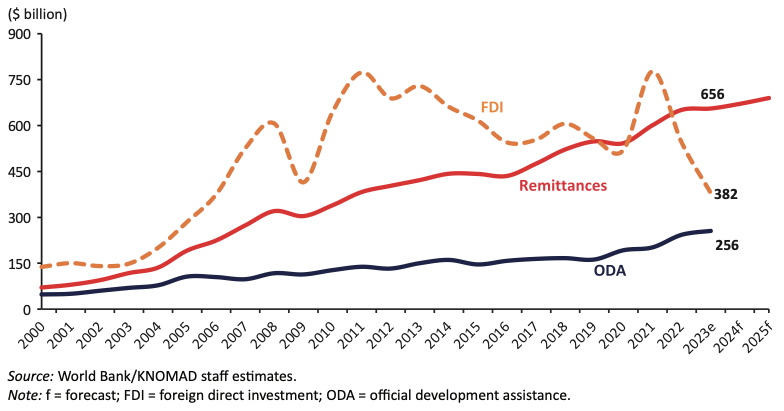
From 2009 to now, the global economy has been on a rollercoaster ride. But in the background, labor migrants keep sending more and more money home.
As a share of the global economy (% global GDP), foreign direct investment is a bit higher than remittances but its role in the global economy is much smaller now, and remittances seem to only ever get more important.
Foreign direct investment is a basic indicator of “globalization” in the sense of free trade and globalized supply chains. It is now at levels similar to the 1990s, before the establishment of the WTO, and nowhere near its Y2K-era peak.
What do remittances mean?
In the film An American Tail (Bluth 1986), a family of mice become new citizens in a “nation of immigrants.” Migration is a symbol, something that stands for something else.
Sending money home is often not about material or practical concerns. It is not an act of desparation; it’s a specific way of being a global worker, consumer, and citizen.
A major purpose for remittances sent by Samoans living overseas is faʻalavelave—gifts of money for community projects (Gershon 2012).
In Cuba, mula facilitate the movement of wealth items to Cuba in exchange for rum, herbs, and other material tokens that connect diasporic families to Cuba. Mula and their wider network use a migrant diaspora to enhance opportunities for their own cash earning but their own and their friends’ and kin’ opportunities for consumption, and by extension social mobility (Cearns 2019)
Temporary male migrants from India work to earn money, to buy gold, to give as presents, to support their female kin when they get married. Remittances (of gold) make someone a good brother (Wright 2020).
If you assume that kinship relations are completely different from economic relations, then temporary migration and remittance networks seem strange.
But this is just one example in which the reciprocal ties that define kinship merge with economic activity in a capitalist labor market. Global capitalism is for many a global informal economy and a means to enable the efflorescence of a system of reciprocity at home.
When Stanford University administrators sent out some advice to their staff about the plans for resumption of on-campus teaching in 2020, they suggested that instructors could consider “leveraging teenagers that might not be engaged” in part-time jobs (Flaherty 2020).
The page has since been deleted from the Stanford University web site but has been archived:
Drell, Persis, and Elizabeth Zacharias. 2020. “Supporting Families during the COVID-19 Pandemic.” Cardinal at Work (Stanford University). July 27, 2020. Accessed Septmeber 7, 2022. http://web.archive.org/web/20201012170506/https://cardinalatwork.stanford.edu/engage/news/supporting-families-during-covid-19-pandemic.
Even before the pandemic, I would argue that the informal economy of care was increasingly necessary to more and more of the middle class in wealthy capitalist societies. It’s not just poor, deprived, or marginalized people who exploit reciprocal ties so they can participate in a capitalist economy.
In 2020 and 2021, many people went into lockdown and lived day after day in their impenentrable household bubble or pod, some people were participating in their families across borders and at long distances.
Jordan, Miriam. 2020. “Even When They Lost Their Jobs, Immigrants Sent Money Home.” The New York Times, September 24, 2020, sec. U.S. https://www.nytimes.com/2020/09/24/us/coronavirus-immigrants-remittances.html.
While some people waited for their next delivery of home gym equipment, and perhaps shook a raised fist at the delays, exclaiming “supply chain problems!!” There was one global flow that kept on going: remittances, cash gifts sent between family members, usually from wealthy countries to poor countries.
Remittances are a major part of the global capitalist system, accounting for a substantial portion of foreign flows of money in many countries. In these countries, it is right to say that their main global export is people. Their remittances are worth over US$650 billion in 2020, down only slightly from 2019 (World Bank 2024b), worth more than the global trade in telephones—US$125 billion, including both cellphones and landlines—and cars—US$645 billion (OEC 2022a, 2022b).
Remittances are also gifts, and more specifically, they are a portion of the wages for commodified labor power appropriated for the purposes of reciprocity. As such they challenge what we know of kinship and of global capitalism.
In previous versions of ANTH 1002, students read the work of Rebecca Prentice (2015). Remittances are another example of what Prentice calls “productive sociality” which she defines as “informal networks of mutual aid” (Prentice 2015, 88). What she finds among workers on the shop floor also takes place across continents. In Prentice’s case, informal social ties also unexpectedly generate value for the bosses of factory workers. Likewise, the productive sociality of remittances also sustains global capitalism itself. The capitalist global economy depends on people’s reciprocity with kin across international borders. We see this not only in remittances but in other kinds of transnational kinship. Like remittances, the practices of kinship in migrant networks weave together caring for family and buying commodities, domains we usually assume are and should be separate.
What are your experiences with sending and receiving money?
Look at Eriksen (2015, 220–23) and Cearns (2019). What are the similarities and differences between the Kula ring of Papua New Guinea and the “Mula ring” described by Cearns? Which is more important for understanding the Mula ring as a social phenomenon in your opinion, the similarities or the differences?
remittances, informal economy, global capitalism
The Vuvale Partnership Agreement is the principal bilateral treaty of cooperation between Fiji and Australia, and includes access to the PALM scheme.↩︎
As some of these news reports suggest, yes, a lot of informal economic activity is technically illegal. When people are excluded from so-called formal, mainstream institutions like banking, property ownership, tax collection, water and sewer systems, electricity, access to courts, police protection, and lack a responsive government, it’s not surprising that they operate on the margins of the law. I mean, where else is left to operate? Protection under the law by state agencies is one of the many things people don’t have; reciprocal ties compensate for this.↩︎